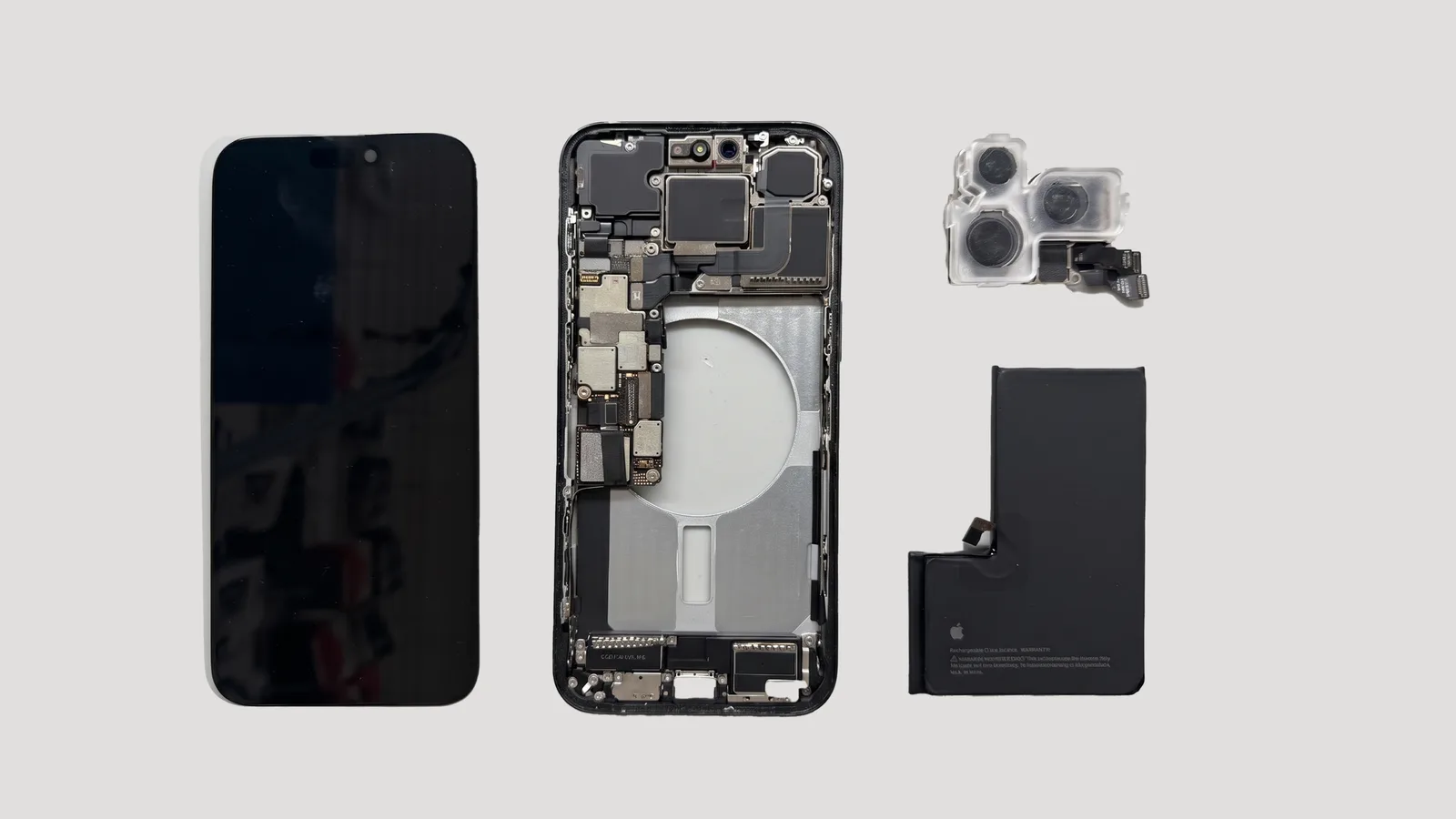
Why Some iPhone Repairs Take an Hour and Others Take Days
The time an iPhone repair takes comes down to three questions:
- Is the part in stock? Repair shops keep the parts that fail most often for the most common iPhone models. Anything else has to be ordered.
- Is the part modular? A screen, battery, or charging port unplugs from the logic board and a new one plugs in. Damage on the board itself needs micro-soldering.
- Is the problem already known? A cracked screen is obvious. An iPhone that will not turn on, or one that got wet, has to be diagnosed before anyone can give a real timeline.
iPhone Repairs Usually Fixed the Same Day
As a general rule, urgent repairs are covered the same day: whatever the iPhone needs to work and stay on. Less common problems can take longer, as the next sections explain. These are also the high-failure parts, so repair shops keep them on hand for popular iPhone models:
- Screen: the most common iPhone repair, and also the fastest. Screens are the part almost every repair shop keeps on hand, so on most models the repair is done on the spot in about 15 to 30 minutes, including a quick test of touch, Face ID, and True Tone.
- Battery: another quick job, usually done in about 40 to 50 minutes.
- Charging port: on iPhone, the Lightning or USB-C port sits on a flex cable together with the bottom microphones, and it is replaced as one part.
- Speakers and microphones: the earpiece and the bottom loudspeaker are common, quick replacements. Microphone problems, such as callers who cannot hear you, are usually solved the same day too.
- Power and volume buttons: the button flex cables are kept in stock for most models.
- Rear and front cameras: usually the same day on popular models when the camera is in stock.
- Camera lens: a cracked rear camera lens cover is a quick, same-day repair, as long as the camera behind it still works.
Back Glass: Two Very Different Repairs
How long a back glass repair takes depends on how Apple built your iPhone:
- iPhone 8 through iPhone 13, plus iPhone 14 Pro and 14 Pro Max: the back glass is bonded to the frame. It has to be separated with a laser machine and cleaned before the new glass goes on. This includes iPhone 8 and 8 Plus, SE (2nd and 3rd gen), X, XS, XR, and the 11, 12, and 13 series. It can usually still be done the same day if you bring the iPhone in early enough.
- iPhone 14, 14 Plus, and the iPhone 15 series and newer: Apple redesigned these models so the back glass comes off as a separate panel. The repair is much faster, and a same-day repair is very likely.
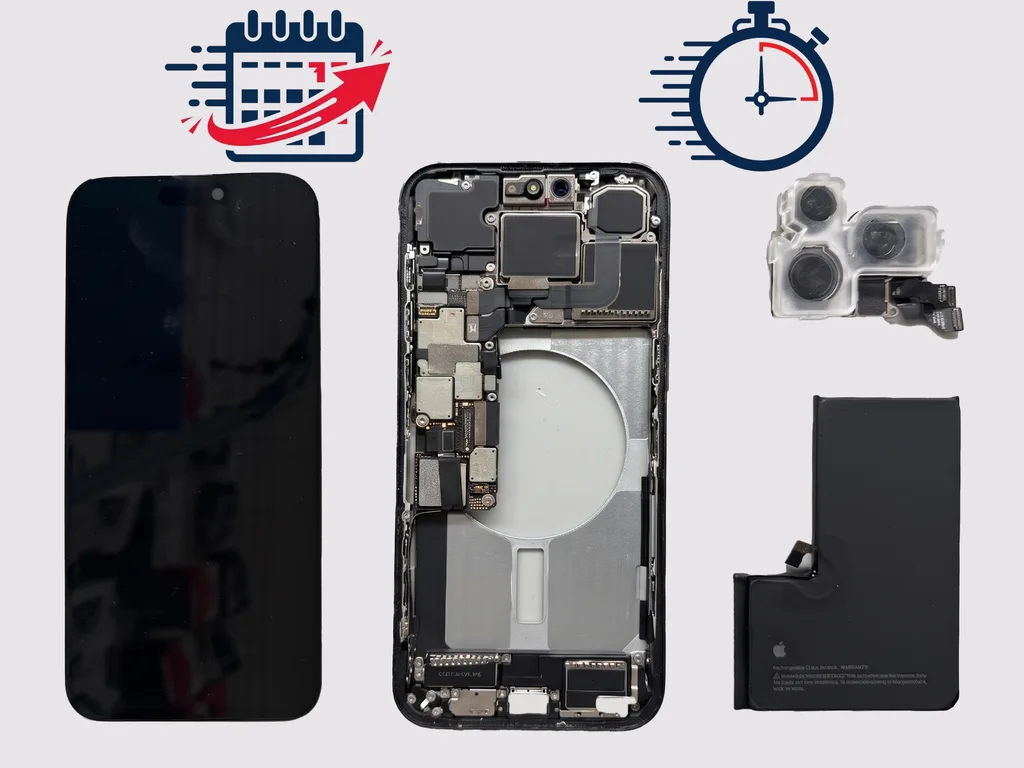
iPhone Repairs That Depend on Part Availability
Some parts are not worth stocking for every model: they are expensive, they rarely fail, or the iPhone is old or uncommon. When the part has to be ordered, the repair usually takes a few extra days.
- Cameras for older or less common models: iPhone camera modules are complex and costly, so shops stock the popular ones and order the rest.
- Internal antennas and sensors: cellular, Wi-Fi, and NFC antennas (NFC is what Apple Pay uses) and some internal sensors rarely fail unless the phone took a hard hit, so they are ordered when needed.
- Air pressure sensor (barometer): it is rarely replaced, so it is usually ordered for the specific model.
- Frame (housing): a bent or badly damaged frame means moving every part into a new housing, and housings are usually ordered for the exact model and color.
iPhone Repairs That Take More Time
- Logic board and micro-soldering: when a chip fails or a connector breaks off the board, the repair is done under a microscope, one component at a time, with testing between steps. These repairs usually take several days.
- Face ID: the Face ID sensors are paired to the logic board at the factory. A broken sensor cannot simply be swapped for one from another iPhone, so Face ID repairs are slow and not always possible.
The Wildcards: Restarts, No Power, and Water Damage
Some timelines cannot be predicted until the technician opens the iPhone.
- iPhone that keeps restarting: most of the time it can be fixed the same day, because the cause is usually a replaceable part such as the battery, the proximity sensor, or a button flex cable. If the fault is on the logic board, the repair needs micro-soldering and takes longer.
- iPhone completely dead: if a new battery or screen does not bring it back, the problem is on the board. The technician has to measure circuits to find the short or the failed component, and that diagnosis alone takes time.
- Water damage: liquid damage is rarely a quick fix. The iPhone is opened, the board is cleaned to remove corrosion, dried completely, and tested part by part. Depending on how far the corrosion spread and whether the damaged parts are in stock, it can be ready the same day or take more than a week, and there is no reliable timeline until the diagnosis is done. Do not charge a wet iPhone or try to turn it on.
iPhone Repair Times at a Glance
| Repair | Typical time |
|---|---|
| Screen | Same day, about 15 to 30 minutes |
| Battery | Same day, about 40 to 50 minutes |
| Charging port | Same day |
| Back glass (iPhone 14, 14 Plus, 15 and newer) | Same day, quick repair |
| Back glass (iPhone 8 to 13, 14 Pro, 14 Pro Max) | Usually same day if dropped off early |
| Speakers, microphones, buttons, camera lens | Same day |
| Cameras | Same day when in stock, a few days if ordered |
| Antennas (cellular, Wi-Fi, NFC) and internal sensors | A few days (part order) |
| Air pressure sensor | A few days (part order) |
| Frame (housing) | A few days (part order) |
| Restarting iPhone (battery, sensor, button) | Usually same day |
| Logic board, micro-soldering | Several days |
| Face ID | Several days, not always possible |
| Water damage | Same day to over a week, after diagnosis |
Need a Same-Day iPhone Repair in Hialeah?
Star Phone Fix completes most iPhone repairs the same day at our Hialeah shop, including screens, batteries, charging ports, back glass, cameras, speakers, and buttons. Diagnosis is free and walk-ins are welcome. When a part has to be ordered or the repair needs board-level work, you get a clear timeline before the repair starts. See every option on our iPhone Repair page.
Frequently Asked Questions
How long does an iPhone screen repair take?
A screen replacement is the most common iPhone repair and usually the fastest. Nearly every shop keeps screens in stock, so on most models it takes about 15 to 30 minutes, including a quick test of touch, Face ID, and True Tone. Rare or very new models may need the screen ordered first.
Why can my iPhone screen be fixed in an hour but my camera takes days?
Screens are the most common iPhone repair, so shops keep them in stock for popular models. Camera modules are expensive and fail less often, so for older or less common models they are usually ordered for your phone, which adds a few days to the repair.
Can a water-damaged iPhone be fixed the same day?
Sometimes, but in many cases it cannot. There is no way to promise a repair time before a diagnosis: the technician has to open the iPhone, clean the corrosion, and test each part to see what was damaged. The timeline also depends on whether the damaged parts are in stock or need to be ordered.
Do I need an appointment for a same-day iPhone repair?
Most repair shops accept walk-ins. Calling ahead with your exact iPhone model is still a good idea: the shop can confirm the part is in stock and set it aside, so the repair starts as soon as you arrive. For laser back glass repairs, arriving early in the day helps.
What is micro-soldering and why does it take longer?
Micro-soldering is repair work done directly on the iPhone logic board under a microscope: replacing tiny chips, rebuilding connectors, or repairing broken traces. It needs special tools and careful testing between steps, so it takes much longer than swapping a modular part like a screen or battery.