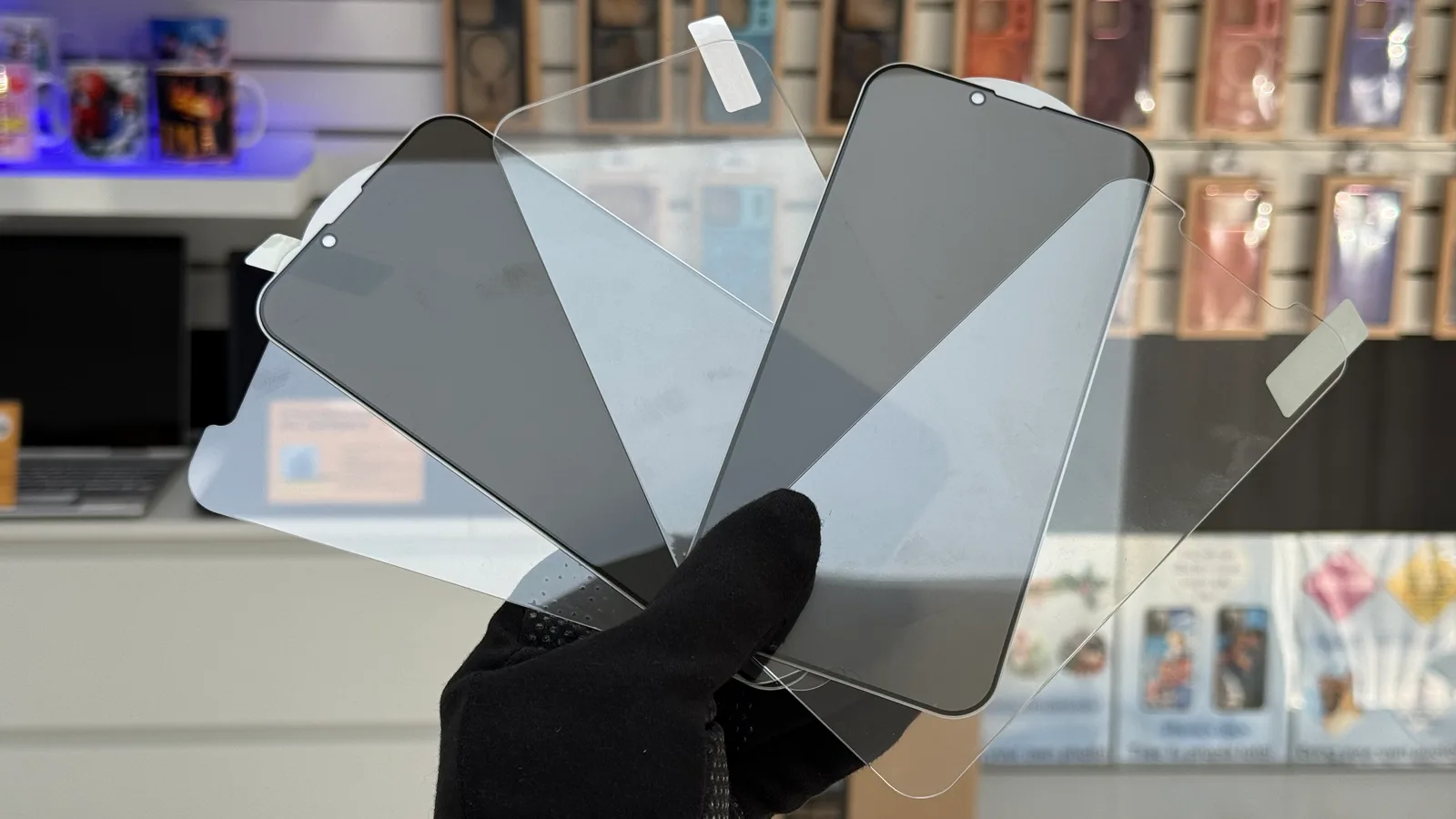
What Is a Tempered Glass Screen Protector?
A tempered glass screen protector is a thin sheet of hardened glass with an adhesive layer. It feels very close to the original screen, it is smooth to the touch, and it resists scratches well.
Because it is rigid, tempered glass is made almost always for flat phone screens. A sheet of glass cannot follow a curved edge, so on curved phones it tends to lift at the sides or leave the edges uncovered. It is also made per phone model, so it exists mainly for phones, not for smartwatches, cameras, or less common devices.
Tempered glass versions
- Clear: maximum clarity, it looks like the bare screen.
- Blue light filter: reduces part of the blue light from the screen, which some people prefer for long evening use.
- Privacy: the screen looks dark from the sides, so only the person in front of it can read it.
What Is a Hydrogel Screen Protector?
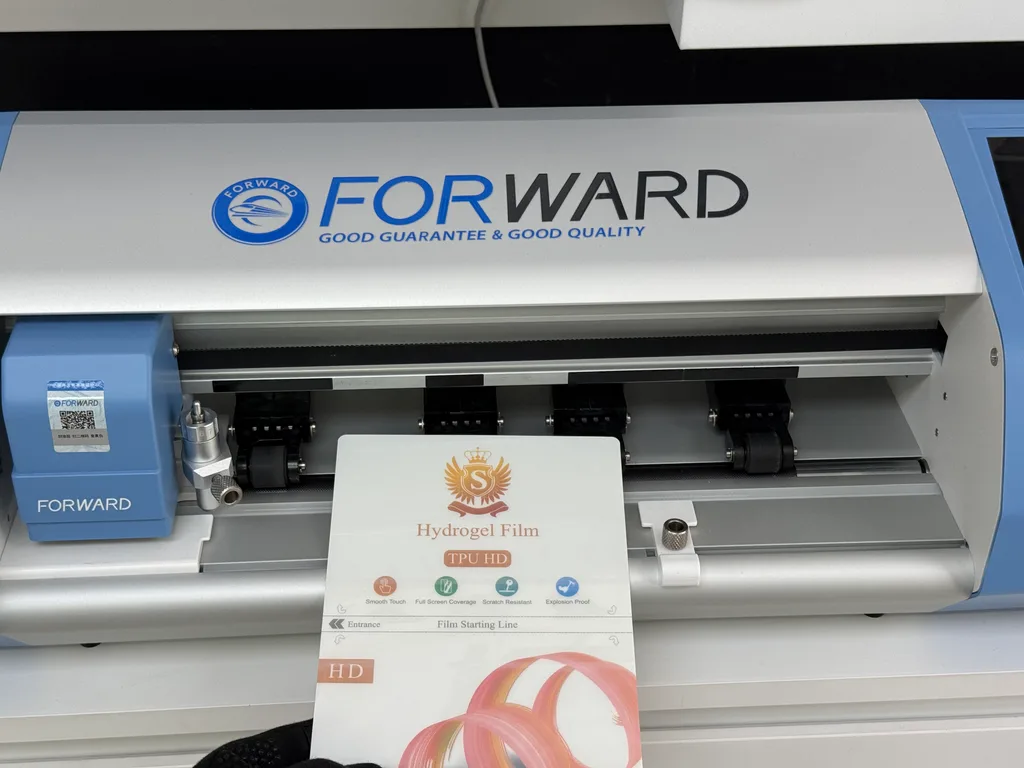
A hydrogel screen protector is a flexible, self-adhering film. Instead of being made in advance for one phone, it is cut on a machine from a digital template of the exact device, so it can fit almost anything with a screen: flat and curved phones, tablets, smartwatches, cameras, and more.
It is thinner than glass and bends around curved edges, so it covers the whole screen and keeps touch response and in-display sensors working normally.
Hydrogel versions
- Clear: keeps the screen looking as it came from the factory.
- Blue light filter: the same filtering idea as the glass version, on a flexible film.
- Privacy: darkens the screen from the sides, also on curved screens.
What Is a UV Hydrogel Screen Protector?
The same three hydrogel versions, clear, blue light filter, and privacy, also come in a UV format. UV versions add one extra step: after the film is applied, it is cured under UV light so the material hardens and becomes more resistant.
It works much like gel nails, which are hardened under a UV lamp. The result keeps the flexible fit of hydrogel, with a harder surface that holds up better to scratches.
Tempered Glass and In-Display Fingerprint Readers
Many phones now have the fingerprint reader inside the screen. On some of these models, such as several Samsung Galaxy S phones with an ultrasonic reader, a tempered glass protector gets in the way: the reader fails, or it needs several tries before it recognizes the finger.
A hydrogel protector is thin enough to let the reader work normally, so it is the usual solution for those phones. If your phone unlocks with a fingerprint on the screen, keep this in mind before choosing glass.
Samsung tip: turn on Touch sensitivity
On Samsung Galaxy phones, turn on Touch sensitivity after installing any screen protector, glass or hydrogel: Settings > Display > Touch sensitivity. It helps the screen register taps better through the protector. It does not fix the fingerprint reader, though: on models where tempered glass blocks the in-display reader, the reader will probably still fail with glass.
Face ID and the front camera
Face ID and the front camera sit at the top of the screen. A protector made for your exact model, clear or privacy, glass or hydrogel, leaves them working normally. When Face ID or the front camera act up after a new protector, the usual cause is a protector that is the wrong size or was placed out of line over the sensors.
Tempered Glass vs Hydrogel: Comparison Table
| Tempered glass | Hydrogel | UV hydrogel | |
|---|---|---|---|
| Material | Rigid hardened glass | Flexible film | Flexible film, hardened under UV light |
| Feel | Closest to the original screen | Smooth, slightly softer | Smooth, harder surface |
| Best for | Flat screens | Flat and curved screens | Flat and curved screens |
| Devices | Mainly phones, cut per model | Almost any device: phones, tablets, smartwatches, cameras | Almost any device |
| In-display fingerprint reader | Can stop it working on some models | Works normally | Works normally |
| Scratches | Protects the screen | Protects the screen | Protects the screen, harder surface |
| Drops | Absorbs part of the impact, no full guarantee | Absorbs part of the impact, no full guarantee | Absorbs part of the impact, no full guarantee |
| Versions | Clear, blue light filter, privacy | Clear, blue light filter, privacy | Clear, blue light filter, privacy |
That adds up to nine options: three tempered glass, three hydrogel, and three UV hydrogel.
What Does Anti-Explosion Mean on a Screen Protector?
Many tempered glass and hydrogel protectors are sold as anti-explosion or explosion-proof. The name sounds like the screen cannot break, but that is not what it means. It describes the protector itself: if an anti-explosion tempered glass protector cracks, a film layer holds the pieces together instead of letting sharp shards come off, and a hydrogel film is flexible, so it does not shatter at all.
Physically, a screen protector adds a layer that absorbs and spreads part of the energy of an impact. In many moderate drops that is enough to keep the shock wave from reaching the screen with full force: the protector cracks instead of the screen, or nothing breaks, and the screen does not end up with the typical spiderweb cracks. But not every impact can be absorbed the same way. A drop on a corner, a hit against a sharp point, or a hard fall can still break the screen under any protector.
- Scratches: a protector fully protects the screen where it covers it, because the protector takes the scratch instead of the screen.
- Drops and impacts: it lowers the risk, but the result depends on the impact. Neither tempered glass nor hydrogel guarantees that the screen will not break.
- Best combination: a screen protector plus a case with raised edges around the screen.
Which Screen Protector Should You Choose?
- Tempered glass: a flat screen, a fingerprint reader that is not in the screen, and you want the feel of the original glass.
- Hydrogel: a curved screen, an in-display fingerprint reader, a smartwatch, a camera, or a less common model.
- UV hydrogel: you want hydrogel with a harder, more resistant surface.
Privacy and blue light filter are versions, not materials: choose the material first, then the version.
Need a Screen Protector in Hialeah?
Star Phone Fix sells tempered glass and hydrogel screen protectors (many of our Spanish-speaking customers call them micas) at our Hialeah shop. We cut hydrogel protectors right in the shop on a machine with a database of almost every phone model on the market, so we can make one for your exact phone. None of the protectors we install, clear or privacy, affect Face ID or the front camera. You can also come in and see a privacy protector placed over your phone, with no obligation to buy, before choosing privacy or clear. If you already bought one, we can also install it for you. See what we carry on our Accessories page. If the screen under the protector is already cracked, see our iPhone screen replacement and Samsung screen replacement pages.
Frequently Asked Questions
Is hydrogel better than tempered glass?
Neither is better for every device. Tempered glass feels closest to the original screen and is the classic choice for flat phone screens. Hydrogel fits curved screens, works with in-display fingerprint readers, and can be cut for almost any device, from phones to smartwatches. UV hydrogel adds a hardened, more resistant surface.
Does an anti-explosion screen protector stop my screen from breaking?
No protector can promise that. Anti-explosion means the protector itself will not shatter into sharp pieces. It absorbs and spreads part of the impact, so in many moderate drops the protector cracks instead of the screen, but a hard fall, a corner hit, or a sharp point can still break the screen under glass or hydrogel.
Can a screen protector stop my fingerprint sensor from working?
Yes, on some phones. Phones with the fingerprint reader inside the screen, such as several Samsung Galaxy S models, can fail to read or need several tries with a tempered glass protector. A thin hydrogel protector lets the reader work normally, so it is the usual solution for those models.
Does a privacy screen protector affect Face ID or the front camera?
Not when it is made for your exact model. Face ID and the front camera sit at the top of the screen, and a protector cut for your phone, clear or privacy, glass or hydrogel, leaves them working normally. Problems usually come from a protector that is the wrong size or placed out of line over the sensors.
Does a privacy screen protector make the screen darker?
A little. The privacy filter blocks light that leaves the screen at an angle, so from the front the screen also looks slightly less bright than with a clear protector. It isn't for everyone: if you keep your phone at low brightness or use it outdoors a lot, a clear protector may suit you better.
What is a UV hydrogel screen protector?
It is a hydrogel protector with one extra step. After the film is applied, it is cured under UV light so the material hardens and becomes more resistant to scratches, similar to how gel nails are hardened under a UV lamp. It keeps the flexible fit of hydrogel.
Can I put tempered glass on a curved screen?
Usually not well. Tempered glass is rigid and is made almost always for flat screens, so on a curved phone it tends to lift at the edges or leave the curved part uncovered. A hydrogel protector bends around the curve and covers the whole screen, edge to edge.